
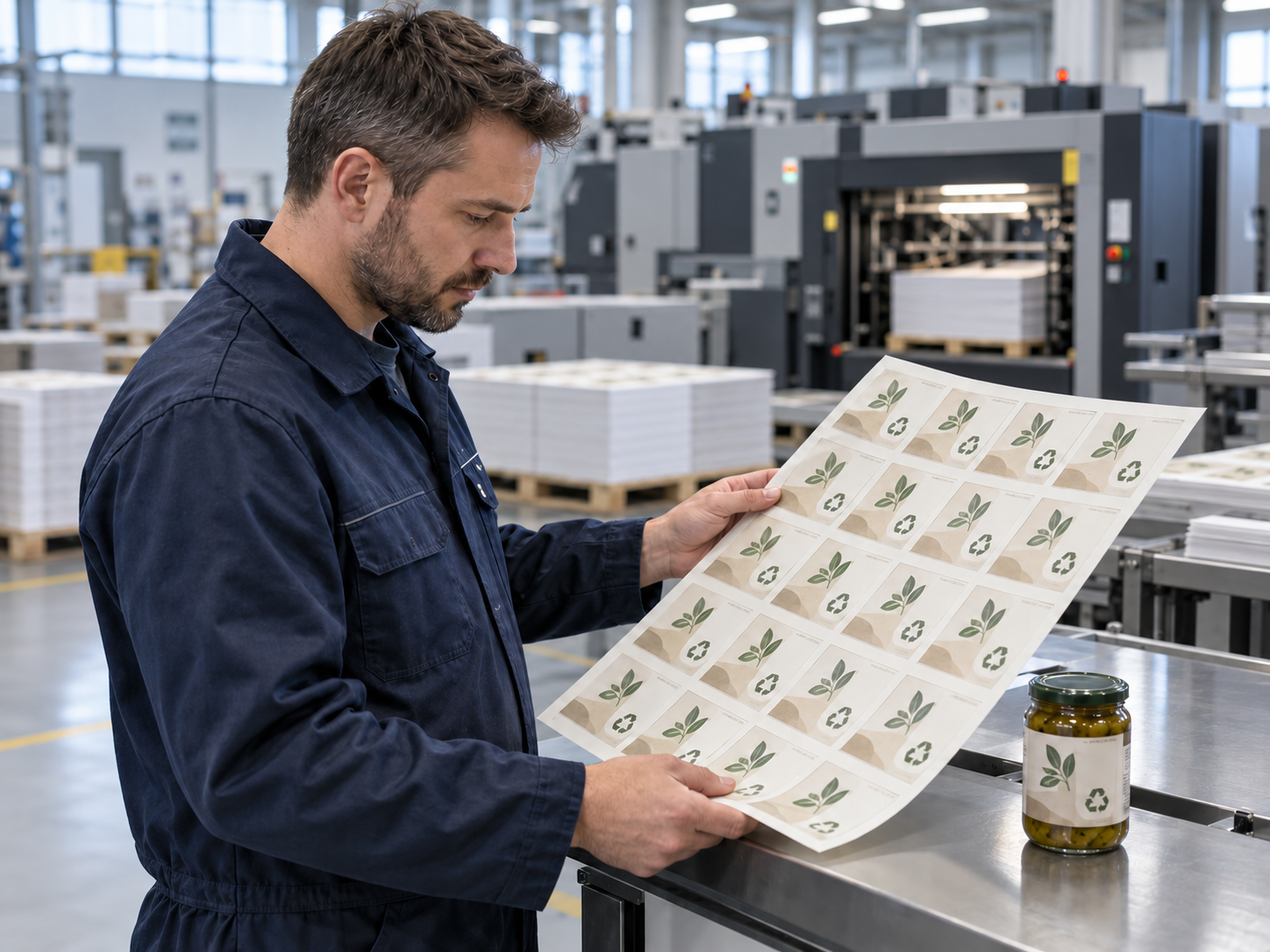
Phrases such as “eco packaging” or “environmentally friendly label” take up little space on a design, but they can suggest more than the manufacturer is able to demonstrate. A green leaf or a symbol resembling a recycling mark works in a similar way: the recipient may get the impression that the message applies to the entire package, even though the substantiated property relates to only one element.
The PPWR Regulation (EU) 2025/40, applicable in principle from August 12, 2026, introduces detailed rules on environmental claims about packaging. For companies that use sheet-fed wet-glue (WGL) labels, this is a good moment to check both the content of the design and the data on the materials used to make the label.
What will you learn from this article?
- When an environmental claim about packaging may be used in accordance with Article 14 PPWR.
- Why you need to state whether a claim concerns the entire package or only an element of it.
- Which phrases and symbols are worth re-evaluating before printing labels.
- How WGL label materials can affect the assessment of the entire package.
- What information to collect from suppliers during a design audit.
What does Article 14 PPWR say about environmental claims?
Article 14 concerns claims relating to properties of packaging for which PPWR sets legal requirements. Such a claim must refer to a feature that goes beyond the applicable minimum requirement. It should also clearly state its scope: the entire packaging unit, a part of it, or all packaging placed on the market by a given operator. Compliance with these conditions must be demonstrated in the technical documentation provided for in Annex VII.
In practice, the statement “the packaging is recyclable” requires a different basis than a statement concerning only the label paper. If the substantiated feature relates to one component, the message should not give the impression that it also describes the jar, the cap and the other elements.
Article 12(8), in turn, refers to marks, symbols and inscriptions that may mislead or confuse recipients in matters covered by PPWR’s harmonized labelling. This does not mean an automatic ban on every proprietary pictogram. Each mark must be assessed in terms of what it actually communicates and whether it conflicts with the relevant requirements.
Which label messages need special attention?
Generic phrases without a specific feature. “Eco”, “green packaging” or “planet-friendly” do not say which element and which property they describe. Alongside PPWR, the rules on unfair commercial practices, amended by Directive (EU) 2024/825, are relevant here. Member States are to apply the provisions introduced by that directive from September 27, 2026.
Symbols suggesting certification or recycling. Before leaving them on a design, it is worth establishing how the recipient will understand them and what evidence supports the message. Nor should you assume that from August 2028 all existing symbols will be replaced solely by EU pictograms. The obligation to use a harmonized label providing information on material composition will start on August 12, 2028, or 24 months after the entry into force of the relevant implementing acts, whichever is later.
“Compostable” and “biodegradable” claims. It is not advisable to use them interchangeably or to suggest that home composting is possible on the basis of evidence concerning industrial conditions. PPWR distinguishes between compostable packaging and packaging compostable in home conditions.
The Möbius loop. The mere absence of a percentage figure next to this symbol does not automatically mean a breach of PPWR. However, you need to check whether, in the given context, the mark suggests recyclability, recycled content, or both, and whether the suggested message is substantiated.
Why must the entire package be assessed in the case of a WGL label?
A label glued to a jar or bottle is part of the packaging solution. Therefore, when assessing a claim concerning the entire package, it is not enough to check the paper alone. The adhesive, inks, varnish and the way the label behaves in a given sorting and recycling process may also matter.
However, there is no single rule under which every WGL adhesive must wash off in a washing bath for a glass package to be recyclable. The assessment depends on the packaging material and the relevant processing method. Similarly, the effect of varnish on sorting must be considered in relation to a specific package, rather than attributing a requirement concerning NIR sorters to every WGL label.
It is also worth separating the requirements concerning different substances. PPWR sets a limit of 100 mg/kg for the sum of concentrations of lead, cadmium, mercury and hexavalent chromium in packaging or its components. Separate restrictions apply to PFAS in packaging intended for contact with food. Regulation (EU) No 10/2011, by contrast, concerns plastic materials and articles intended to come into contact with food; it is not a general conformity standard for all printing inks.
How to audit labels before printing?
- Review the text and graphics. List all phrases, marks and illustrations that may suggest an environmental benefit. For each, note exactly which feature it describes and whether it concerns the entire package or a part of it.
- Check the basis for the claim. Collect documents from suppliers appropriate to the specific statement: material specifications, test results, composition information, or confirmation of properties relevant to the given recycling process. Not every claim requires the same laboratory test.
- Establish responsibility for the documentation. The technical documentation from Annex VII is the basis for the conformity assessment, and Article 39 concerns the EU declaration of conformity of the packaging. Under Article 15(3), the manufacturer keeps the technical documentation and the declaration for 5 years for single-use packaging and 10 years for reusable packaging, counted from the time the packaging is placed on the market.
How do we help at DrukujemyEtykiety.com?
We specialize in sheet-fed wet-glue (WGL) labels. Before printing starts, we can check the design for the legibility of marks, compliance with the agreed technical specification, and environmental claims that require additional substantiation. We also help determine what data on the materials used the customer needs to assess the entire package.
The scope of documents and tests should be confirmed for a specific project. The label’s raw-material documentation alone does not replace the assessment of the complete package or its EU declaration of conformity.
Check your labels: greenwashing and PPWR checklist
Go through a free checklist of 12 control questions about environmental claims, declarations and documents for sheet-fed WGL labels. It is a preliminary assessment that shows what is worth clarifying before the label goes to print. The checklist is available in Polish.
Open the greenwashing and PPWR checklist (Polish)
Book a free label audit
Already have a label design but want to check it before printing? Send us the file and information about the packaging. We will look at the marks, barcodes and technical aspects of preparing the WGL label. We will also point out the environmental claims for which it is worth completing the documentation or clarifying the scope of the claim.