
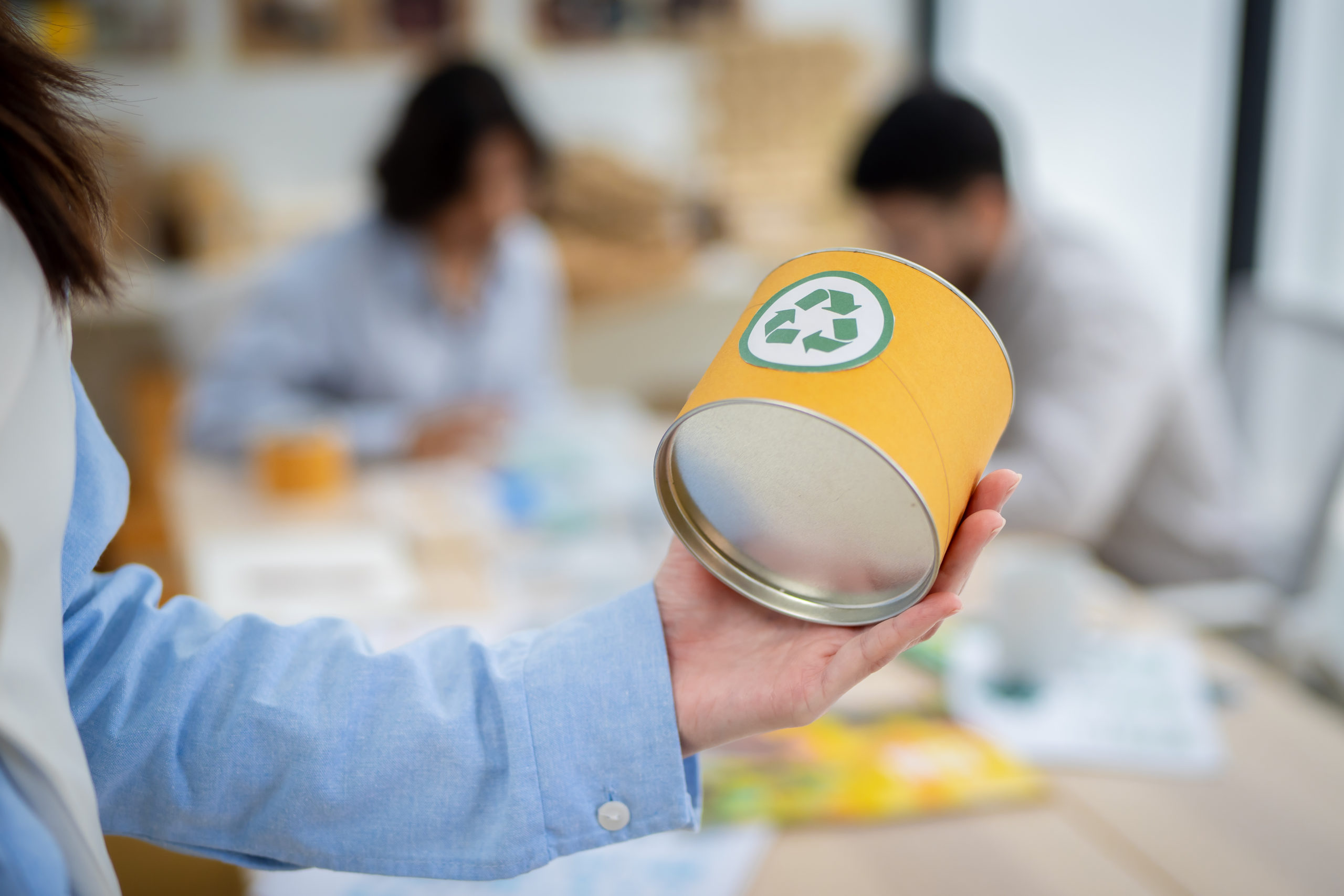
On August 12, 2026, the key provisions of the PPWR (Packaging and Packaging Waste Regulation) on packaging labelling will start to apply. The regulation itself entered into force on February 11, 2025 and, as an act directly applicable in all EU Member States, it will change the way packaging is designed across the European Union. For many manufacturers, however, the biggest surprise is that the new rules will also have a major impact on product labels themselves.
Until now, a label was primarily a marketing tool and a carrier of mandatory product information. PPWR makes it part of the waste management, recycling and environmental compliance system as well.
This means that some current label designs will need not only updated content but, in some cases, a complete redesign.
1. Mandatory sorting marks on labels
One of the main goals of PPWR is to harmonize the rules for sorting packaging waste across the EU. Ultimately, this means introducing harmonized marks that are legible and understandable regardless of the country in which the product is sold.
The planned harmonized marks are meant to indicate, among other things:
- what material the packaging is made of,
- which waste stream it should go to,
- how to sort it correctly.
For manufacturers, this poses very concrete design challenges. Labels will have to make room for additional marks while preserving the legibility and visual appeal of the product. In many cases, current designs will need to be updated and adapted to different language versions and export markets.
The FMCG, cosmetics and dietary supplement industries, as well as internationally operating manufacturers, will feel this most strongly.
2. An end to unsubstantiated “eco” claims and greenwashing
One of the most important changes will be a tougher approach to environmental communication on packaging. The regulation clearly states that labelling must not mislead the consumer or suggest environmental properties that cannot be substantiated.
As a result, popular phrases such as the following will come under closer scrutiny:
- “eco”,
- “green”,
- “100% recyclable”,
- “biodegradable”,
- “environmentally friendly”.
For many companies, this will mean having to re-examine the marketing communication on their labels. The problem is that even seemingly innocent wording can be considered greenwashing if it is not backed by appropriate documentation or by the actual properties of the packaging.
This is an important change, because until now many environmental messages worked more as marketing than as precise environmental declarations.
3. The label will affect the recyclability of the entire package
This is one of the most underestimated topics related to PPWR. Many manufacturers focus on the packaging itself, forgetting that the label also affects whether it can be recycled.
The new rules promote design in line with the principles of Design for Recycling, that is, design with recycling in mind. What will be assessed is therefore not only what a bottle or container is made of, but also:
- the type of label,
- the adhesive used,
- lamination,
- inks,
- metallic elements,
- whether the label can be separated during recycling.
A poorly chosen label can genuinely lower the recyclability class of the entire package.
A good example is a full shrink sleeve label that tightly covers a PET package. Although the bottle itself may be recyclable, too much print coverage or an unsuitable label material can hinder optical sorting in recycling facilities.
From 2030 this will matter even more, because PPWR introduces recyclability classes for packaging. Packaging that does not meet the minimum requirements may not be allowed to be placed on the EU market.
4. More mandatory information on the same label area
The new obligations mean more information that has to fit on the same area. In addition to classic product data, there will be extra environmental marks, sorting instructions and digital solutions.
The following will play an increasingly important role:
- QR codes,
- GS1 Digital Link,
- reuse marks,
- digital sources of product information.
This makes label design far more complex today than it was just a few years ago. Manufacturers must simultaneously ensure regulatory compliance, legibility, aesthetics, and the ability to integrate with logistics and retail systems.
Increasingly, it will be necessary to think of a label not only as a graphic design but as an element of the entire product information system.
5. PPWR and the development of GS1 standards are accelerating the growth of digital labels and 2D codes
Regulatory changes coincide with a major technological transformation in trade and logistics, linked to the GS1 Sunrise 2027 initiative. Standard EAN codes are gradually becoming insufficient, and the market is preparing for wider use of 2D codes.
With solutions such as GS1 Digital Link or Digimarc, a single label can at the same time:
- identify the product,
- convey logistics data,
- lead to environmental information,
- support marketing activities,
- facilitate export and compliance with regulatory requirements.
For manufacturers, this means having to think about labels in a much more strategic way than before.
6. New marks for reusable packaging and reuse systems
PPWR strongly promotes reuse and refill systems, so there will also be new requirements for marking reusable packaging.
This applies, among other things, to:
- returnable packaging,
- refill systems,
- reusable transport packaging,
- marks indicating how to return and reuse the packaging.
This is particularly important for the HoReCa sector, beverage producers, e-commerce and companies that use transport packaging. It is worth checking already today whether your current label designs will allow additional reuse marks to be implemented easily.
7. Companies must start preparing much earlier than 2030
Although many companies associate PPWR mainly with 2030, the first obligations will start to apply as early as August 2026. And implementing label-related changes usually takes time.
The whole process usually includes:
- audits of current packaging,
- material analysis,
- legal consultations,
- design changes,
- production tests,
- updating label designs,
- agreements with suppliers and printers.
The more products, sizes and label versions for export markets a company has, the more complicated implementing the changes becomes. That is why companies that start preparing early enough will have much greater control over costs and the implementation schedule.
How can we help prepare your labels for PPWR?
For many companies, the biggest challenge will not be learning the rules themselves, but translating them into a real label and packaging design.
At DrukujemyEtykiety.com, we help manufacturers prepare labels that comply with the new PPWR requirements, both from the technical and the design side.
We can support your team with, among other things:
- analysis of your current labels against future PPWR requirements,
- verification of marks and environmental communication,
- selection of materials and solutions that support recycling,
- designing labels in line with Design for Recycling principles,
- implementing QR codes, GS1 Digital Link and 2D marks,
- preparing new versions of label designs and sorting marks,
- optimizing labels for export and different EU markets.
If you want to check whether your current labels are ready for the upcoming changes, contact Piotr Przybylski directly. Piotr will carry out a free initial analysis of your packaging and advise on the steps to take before the new rules become mandatory.
Piotr Przybylski
New Business Manager – DrukujemyEtykiety.com
tel. +48 501 748 636
e-mail: p.przybylski@drukujemyetykiety.com